
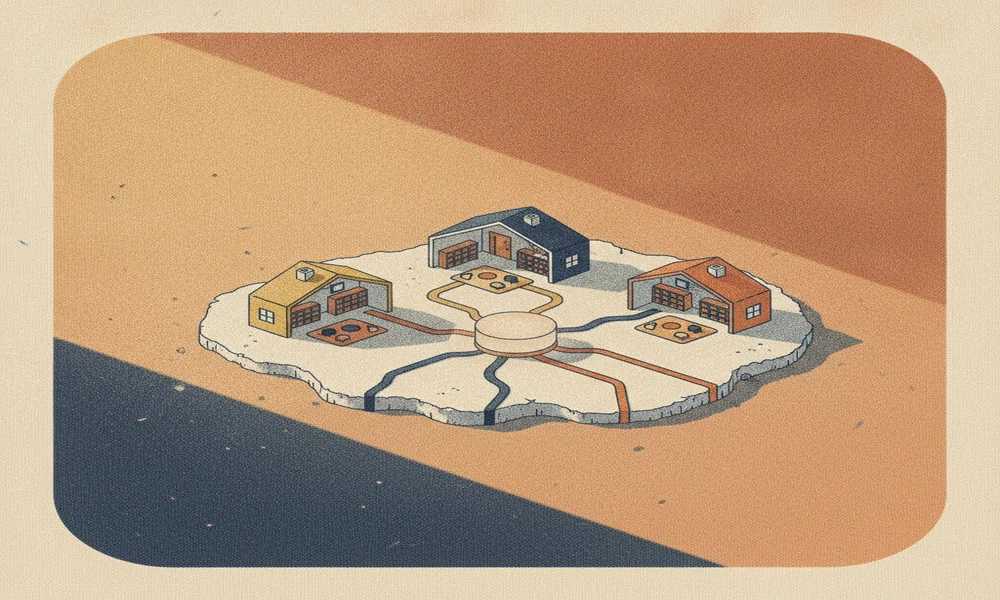

- A single source of truth gives every child one shared record, so head office and every branch read and write the same data instead of drifting spreadsheets.
- Standardized SOPs enforce the same admission workflow, fee structures and forms at every location, so branch three behaves like the flagship.
- Consolidated reporting lets you switch between a group-wide roll-up and a drill-down into any single branch, so weak and strong sites sit side by side.
- Role-based access scopes visibility by role, so a branch head sees only their location while the owner sees across the whole chain.
- Shared records make transfers, promotions and staff reassignment a simple reference change, so a child’s history follows them with no re-keying.
- Centralization is what lets you add locations without losing operational control, which matters more than any feature count.
Table of contents
- One shared record per child
- Standardizing SOPs across branches
- Group roll-ups and fee numbers
- Role-scoped access across sites
- Transfers and promotions
- Scaling without losing control
Preschool ERP software earns its place in a growing chain the moment you can no longer hold every branch in your head. Picture a Friday afternoon. The owner of three preschool branches has three screens open: one spreadsheet from the first branch, a different app login for the second, a WhatsApp message from the third. The same child, Aarav, shows two different outstanding fee amounts. Which one is right? From head office, there is no way to tell without calling each branch and waiting for someone to pull a file.
Here is the thing most feature comparisons miss. When you run more than one location, the real problem is not that you lack modules. It is divergence. Each branch quietly grows its own records, its own fee logic, its own forms and its own daily routines, and over time the three sites stop being one organization. The point of an ERP across locations is not a longer feature list. It is centralization: one shared system that makes many sites behave as one. Done right, multi-location preschool management stops being three jobs and becomes one. This post walks through what that system actually centralizes, mechanism by mechanism, so you can map it onto your own chain.
One record per child, read by every branch: the single source of truth that ends data drift
Start with the idea that makes everything else possible. A single source of truth is an arrangement in which every piece of data is mastered, or edited, in only one place. Every system then references that one authoritative record instead of keeping independent copies that can slowly drift apart. It exists for one reason: to stop the mistaken inconsistencies that happen when a duplicate copy somewhere gets forgotten.
Put that into preschool terms. In a centralized preschool management system, Aarav’s record lives once, and every branch and head office read from that same record and write back to it:
- his enrollment
- his fee ledger
- his attendance
- his documents
One record, many readers. That is why head office can trust the fee number on the screen without calling anyone.
Now the failure mode. When each branch keeps its own spreadsheet or its own copy of an app, you get what integration people call islands of automation, or information silos. Identical data sits in several places at once, and each copy drifts away from the others. Patching those separate systems together gets ugly fast. For any number of points, the count of fully connected links grows as n(n-1)/2, so ten separate tools would need forty-five connections between them. That is enterprise application integration math, and it is why bolting branch systems together never really works.
The cost of divergence is real and measured. A 2024 study of business spreadsheets found that 94% of them contained errors, the kind that lead to poor decisions, pricing mistakes and operational problems. The lead researcher was Prof. Pak-Lok Poon. Bad data gets expensive at scale too: Gartner estimates poor data quality costs organizations an average of $12.9 million a year. There is even a rough rule of thumb, often called 1x10x100, that a data problem fixed at its source costs about 1x, but close to 100x once it reaches the people relying on it.
So here is the decision. The question is not which preschool ERP system has more modules. It is whether all your branches share one record. If they do not, you have not removed the silos. You have only digitized them.
Why branch three should feel like the flagship: standardizing SOPs across every location
A parent should get the same experience at your newest branch as at your first one. That only happens when the system makes it happen. Multi-branch preschool management software enforces the same admission workflow, the same fee structures, the same forms, the same naming and the same daily routines at every site. A family enrolling at branch three walks through the same steps as a family at the flagship. An auditor sees the same records, laid out the same way, everywhere.
This is the whole point of preschool franchise management software. A franchise is a promise that the brand behaves the same at every address. You cannot keep that promise if each franchisee invents their own intake form and their own fee rules. A shared system removes the variance and the rework. It does not do this by magic, and not by saving some headline percentage of time. It does it by giving every branch the same fields to fill in.
There is good evidence that standardized fields beat free typing. A 2012 study found that structured, checkbox-style data capture produced about 0.46 errors per 10,000 fields, against 3.70 for a single pass of manual typing. That is roughly an eight times reduction, and it matched the accuracy of entering everything twice by hand. Standardized forms at every branch are the mechanism behind that accuracy.
Notice what makes this possible. You can only enforce one admission workflow across branches if those branches share one set of records. Standardization is not a separate feature you buy on top of centralization. It is what centralization lets you do.
Seeing every branch from one screen: group roll-ups and the fee numbers that matter
Because one dataset feeds everything, preschool operations management software lets you switch between two views in seconds:
- a group-wide roll-up that shows total enrollment, occupancy, collections and outstanding fees across every branch at once
- a drill-down that opens any single branch on its own
Weak and strong sites sit side by side on the same screen, so you can compare instead of guess. This changes how you make decisions. You read the roll-up first to find the branch that is off, then you drill into that one branch to see why. You stop reacting to whichever manager emails you loudest. That workflow is only possible when preschool management software for multiple locations pulls from one shared record, not from three reports that arrive in three different formats on three different days.
The fee numbers are where this pays off most. One useful measure is Days Sales Outstanding, or DSO, the average number of days it takes a credit sale to turn into cash. You calculate it as accounts receivable divided by net credit sales, times the number of days. A high DSO means collection is slow or difficult and your cash flow is under strain. A low DSO means money is coming in cleanly. What counts as acceptable varies by industry and company size, so there is no single target. The value for a chain is this: you can see which branch concentrates the slow collection, from head office, without a site visit.
Parents increasingly expect to pay online, and in India that is now the default. UPI accounts for about 84% of India’s digital payment volume and close to 49% of the world’s real-time payment volume. Centralized fee tracking is what makes that payment show up instantly in your group numbers the moment a parent taps pay.
One caution. Do not expect a dashboard to hand you a return-on-investment figure. It will not. What it gives you is honest KPIs you can track yourself:
- occupancy per branch
- collections against what you billed
- DSO per branch
Those tell you where to act. The action is still yours.
Centralized does not mean everyone sees everything: role-scoped access across sites
Here is the worry every owner raises when they hear the word centralized. If one system holds every branch, does everyone now see every child’s file? No. The mechanism that prevents it is role-based access control, usually shortened to RBAC.
The idea is simple. Each user is assigned one or more roles, and each role is assigned the privileges that role is allowed to have. Permissions attach to the role, not to the person, so you manage access at the level of the organization instead of editing one account at a time. This is not a vendor invention. It is settled practice, a formal model introduced by Ferraiolo and Kuhn in 1992 and later written into an ANSI standard.
Map that onto good preschool branch management:
- a branch head sees only their own location
- a regional manager sees their cluster of branches
- the owner sees across all of them
Centralized school management software gives head office full visibility without forcing every branch to see into every other branch. Preschool administration software that scopes access by role is exactly how you stay centralized and controlled at the same time. You hand out one record shared across the chain, and you still decide who reads which part of it.
When a family moves across town: transfers and promotions as a reference change
A family moves to the other side of the city and wants to keep their child at your brand, just at a closer branch. On a shared system, that move is a reference change, not a re-enrollment. The child’s history, fee ledger and documents follow along because the record never actually moved. Only the branch it points to changed. Promoting a child to the next class level works the same way, and so does reassigning a teacher from one center to another.
Picture the alternative. Without one shared system, a transfer means creating the child from scratch at the new branch. Someone re-types the history. The old fee ledger gets left behind. You end up with two partial records for one child, which is the exact divergence problem from the first section, showing up at the worst possible moment, in front of a parent.
This is the everyday test of real multi-centre preschool management. Can a child cross branches without anyone re-keying their life? When the answer is yes, you are doing multi-location preschool management on one system, the way it is meant to work. An All in One Preschool Management Solution handles transfers, promotions and automatic fee allocation as simple record operations, because the record is shared from the start.
Scaling locations without losing control
The real goal was never a bigger feature list. It was adding locations without losing your grip on how they run. That is a centralization problem first and a feature problem second.
So judge any preschool ERP software by a single question: does every branch share one record? Get that right, and the rest follows almost on its own:
- standardized SOPs follow
- group reporting follows
- role-scoped access follows
- clean transfers follow
Get it wrong, and more features only make the silos look fancier while the divergence keeps growing underneath. A chain that shares one record scales. A chain of separate systems just gets harder to see.
Multi-location preschool management done well looks like one organization that happens to have several addresses, not several businesses that happen to share a logo. That is the shape of an Online Learning Management System, and it is centralized school management software working as it should: one record, many branches, full control.
FAQs
What is preschool ERP software and how is it different from a single-site app?
Preschool ERP software is a single system that runs several locations as one organization, rather than a standalone app that manages one center in isolation. A single-site app keeps its own records on its own, so each branch that uses a separate copy drifts apart from the others. An ERP puts every branch on one shared set of records, which is what lets head office see and coordinate the whole chain.
What does a centralized preschool management system actually centralize across branches?
A centralized preschool management system centralizes the records themselves, keeping one authoritative version of each child’s enrollment, fee ledger, attendance and documents that every branch reads from and writes to. On top of that shared record it standardizes admission workflows, fee structures and forms, and it consolidates reporting so group totals and single-branch views come from the same data. Access is scoped by role, so centralized does not mean everyone sees everything.
Is preschool franchise management software different from running one center?
Yes. Preschool franchise management software exists to keep the brand behaving the same way at every address, which a single center never has to worry about. It enforces the same forms, fee rules and daily routines across franchisees, so a parent gets the same experience everywhere. Running one center only needs internal consistency, while a franchise needs that consistency enforced across many owners and sites.
The Role of Preschool ERP Software in Managing Multiple School Locations
